You Won’t Believe What I Saw in Fes – A View Like No Other
Walking through the ancient medina of Fes, I wasn’t just seeing a city—I was witnessing layers of history unfold before my eyes. The way sunlight hits the mosaic walls at golden hour, the endless maze of alleys revealing hidden rooftops, and the sudden panoramic views from quiet terraces—it all adds up to something unforgettable. This isn’t just sightseeing; it’s a visual journey through time. If you’re chasing real, raw beauty, Fes delivers in ways you never expected.
Stepping Into a Living Postcard
Arriving in Fes, the transition from the modern city to the walled medina feels like stepping into another dimension. The outer world of paved avenues and contemporary buildings quickly gives way to a skyline dominated by minarets and a labyrinth enclosed by ochre-colored ramparts. The Bab Bou Jeloud gate, with its intricately carved plaster and blue-tiled façade, serves as a grand portal, welcoming visitors into a realm where time slows and every sense sharpens. This contrast is not just architectural—it’s emotional. One moment you're navigating traffic and digital signs, and the next, you're enveloped in the hush of narrow alleys where donkeys carry goods and the scent of cumin and cedar lingers in the air.
The first visual impression of the medina is one of textured depth. Centuries of sun, wind, and handcraft have shaped the stone walls into a tapestry of cracks, stains, and patinas. These are not flaws—they are signatures of endurance. The surfaces shimmer in the daylight, catching the light at odd angles, revealing details that weren’t visible moments before. Hand-hammered lanterns hang outside workshops, casting dappled shadows that dance with the breeze. As the sun climbs, the interplay of light and shadow turns even the simplest alley into a living gallery.
This initial sensory immersion sets the tone for the entire journey. Fes does not present itself all at once. It reveals itself gradually, in fragments—a sliver of courtyard, a glimpse of tilework, the echo of a call to prayer bouncing off ancient walls. There’s a rhythm to the discovery, one that encourages slowness, attention, and presence. For travelers accustomed to curated experiences and instant access, the medina offers a refreshing challenge: to let go of control and allow the city to unfold on its own terms. This deliberate pace transforms sightseeing into something deeper—an act of witnessing.
The Magic of Getting Lost (On Purpose)
In most cities, getting lost is a nuisance. In Fes, it’s a strategy. The medina’s maze of over 9,000 alleys is not designed for efficiency—it’s designed for exploration. Wandering without a map, or at least without overreliance on one, becomes a way of engaging with the city more authentically. GPS signals falter, street signs are scarce, and even locals admit that navigation here is as much intuition as memory. But within this disorientation lies a kind of clarity—an invitation to look more closely, to notice what you might otherwise overlook.
Some of the most memorable views in Fes come not from guidebook highlights but from chance encounters. A spiral staircase tucked behind a spice vendor might lead to a sunlit courtyard where orange trees grow in cracked terracotta pots. An arched doorway, slightly ajar, reveals a coppersmith shaping a teapot with rhythmic precision, his hands moving with the confidence of generations. Around a blind corner, a silent plaza opens up, framed by cedarwood balconies adorned with geometric latticework. These moments are fleeting, unrepeatable, and all the more precious for their unpredictability.
Getting lost also shifts your relationship with time. Without a strict itinerary, you’re free to pause, to linger in a shaded alcove, to watch children kick a soccer ball through a narrow passage. You begin to notice patterns—the way laundry hangs like prayer flags between buildings, how cats navigate rooftops with silent authority, or how the call to prayer marks the day in five gentle waves. These aren’t tourist attractions; they’re everyday rhythms, and they form the quiet backbone of Fes’s visual poetry.
For the traveler seeking beauty, this kind of wandering is essential. It trains the eye to see not just landmarks, but life. It replaces the checklist mentality with a more contemplative approach—one that values serendipity over certainty. In a world where every experience feels optimized, Fes reminds us that some of the best moments happen when we stop trying to control them.
Rooftop Revelations Across the Medina
If the alleys of Fes are its veins, then the rooftops are its lungs—spaces of breath, perspective, and quiet reflection. Accessing these elevated vantage points is one of the most rewarding ways to experience the city. Some guesthouses welcome visitors to their terraces with a mint tea invitation; others, like small rooftop cafés, offer simple stools and panoramic views. Even a tucked-away museum or a tucked-in riad can provide a moment of vertical escape from the medina’s horizontal maze.
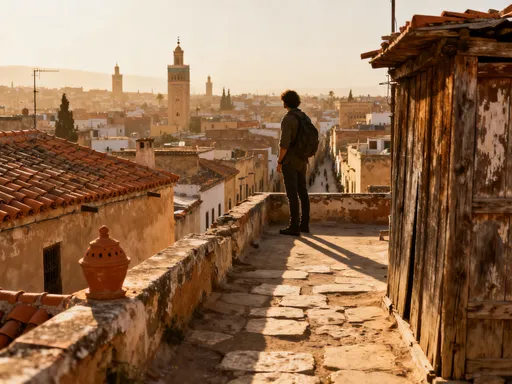
From above, Fes transforms. The chaotic tangle of alleys resolves into a pattern—a sea of terracotta rooftops, each one slightly uneven, like waves frozen in time. Minarets rise like sentinels, their green-tiled spires cutting through the skyline. The Kairaouine Mosque, one of the oldest universities in the world, anchors the city with its grand presence, while smaller mosques dot the landscape like punctuation marks. In the distance, the hills form a protective embrace, their slopes dotted with white-washed homes and cypress trees standing like exclamation points.
This shift in elevation does more than offer a pretty view—it changes your understanding of the city. On the ground, Fes feels intimate, almost claustrophobic at times. From above, you grasp its scale, its density, its organic growth over centuries. You see how neighborhoods cluster around mosques, how courtyards function as private oases, and how life unfolds in layers—ground level for commerce, upper floors for living, rooftops for gathering and contemplation. This verticality is part of what makes the medina a living city, not a museum piece.
The best rooftop moments happen at golden hour, when the low sun bathes the rooftops in amber light. Shadows stretch long, walls glow, and the air takes on a golden haze. It’s a time when photography feels almost unnecessary—because the memory imprints itself. But it’s also a time for stillness, for sitting quietly and absorbing the scene. The call to prayer drifts upward, mingling with the distant clink of dishes and the laughter of children. In these moments, Fes doesn’t just reveal its beauty—it shares its soul.
Windows, Arches, and Framed Beauty
In Fes, architecture is not just shelter—it’s a language of vision. Doorways, arches, and mashrabiya screens (lattice windows) function as natural picture frames, directing the eye toward carefully composed scenes. Unlike the wide-open vistas of modern cities, Fes teaches you to see in fragments, each one curated by centuries of design tradition. A simple stone arch might frame a woman carrying a basket of bread; a wooden window might spotlight a cat leaping between rooftops; a latticed screen might filter sunlight into delicate patterns on a courtyard wall.
These architectural elements are not decorative—they are intentional. Moroccan design has long embraced the idea of controlled visibility, where beauty is revealed gradually, through layers. A courtyard may be hidden behind a heavy door, only visible after you’ve passed through a dim corridor. A garden may be glimpsed through a keyhole arch, its full splendor withheld until you step inside. This principle of framed viewing encourages patience and rewards attention. It turns every walk into a series of reveals, like turning the pages of a visual storybook.
For the observant traveler, this creates endless opportunities for quiet appreciation. A laundry line strung between buildings becomes a line of color against the sky. Children playing in a narrow alley form a spontaneous tableau. A craftsman bent over his work is framed by the doorway of his shop, his tools arranged like still-life elements. These are not staged scenes—they are everyday moments, elevated by the way they are seen. In a world saturated with images, Fes offers a different model: one where beauty is found not in perfection, but in presence.
This idea of intentional composition extends beyond architecture. It reflects a cultural value—one that honors craftsmanship, patience, and the dignity of ordinary life. To walk through Fes is to be taught how to look: not greedily, not quickly, but with care. The city doesn’t offer everything at once. It asks you to slow down, to pause, to notice the detail within the whole. And in doing so, it transforms the act of seeing into an act of respect.
Chasing Light: Time of Day and Visual Transformation
One of the most remarkable things about Fes is how it changes with the light. The city is not a static image—it’s a living canvas, repainted with every shift in the sun. At dawn, a soft mist rises from the alleys, softening edges and muting colors. Stone walls appear ghostly, and the air is still. This is the quietest time, when the medina feels most private, as if it’s breathing in after the night. It’s an ideal moment for photography, not for grand vistas, but for intimacy—steam rising from a bread oven, a shopkeeper unlocking his stall, the first call to prayer echoing across rooftops.
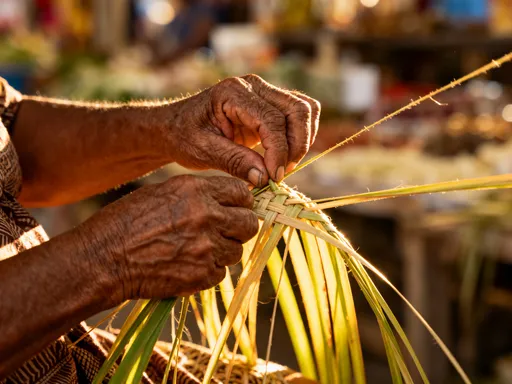
By midday, the light becomes sharp and revealing. The sun climbs high, casting short shadows and illuminating details that were hidden in the morning gloom. This is when the craftsmanship of Fes truly shines. Zellige tilework—hand-cut geometric mosaics—glows with color. Intricate plaster carvings on doorways and fountains come alive with texture. Even the worn steps of ancient staircases show their history in every groove. While the heat can be intense, the clarity of vision is unmatched. It’s the best time to visit artisan workshops, where natural light floods through high windows, illuminating the hands of potters, weavers, and leather dyers at work.
Then comes golden hour—the time when Fes becomes magical. The sun dips low, casting a warm, amber light across the rooftops. Walls that looked dull in the midday sun now appear to be on fire, their surfaces glowing with hidden warmth. Shadows stretch long, creating dramatic contrasts. This is the most photographed time, and for good reason. But it’s also a time for stillness. Sitting on a rooftop, watching the city bathe in this light, feels like witnessing a daily ritual—a moment of beauty that repeats itself, yet never feels routine.
At night, Fes takes on a different character. Electric lanterns glow in doorways, casting pools of warm light on cobblestones. The alleys become intimate, almost secretive. The sounds change—footsteps echo, conversations drift from upper windows, and the occasional burst of music floats from a hidden courtyard. While the medina is not brightly lit, this dimness adds to its charm. It forces you to move slowly, to rely on other senses, to trust the path beneath your feet. Nighttime in Fes is not about visibility—it’s about atmosphere.
Beyond the Medina: Broader Perspectives
While the medina is the heart of Fes, the city’s visual story extends beyond its walls. Stepping outside the ancient gates offers a chance to see Fes from a distance, to understand its place within the landscape. Two of the most rewarding viewpoints are Dar Batha and the Jnan Sbil Gardens. Neither is as crowded as the main tourist spots, and both offer a more structured, contemplative experience.
From the terraces of Dar Batha, a former royal palace turned museum, you can see the medina spread out like a topographical map. The sea of rooftops, the winding alleys, the clusters of minarets—all come into focus. The building itself, with its Andalusian-style courtyard and carved stucco, provides a quiet frame for the view. It’s a place where art and landscape merge, where the beauty of human creation meets the beauty of urban form. The museum’s collection of ceramics, textiles, and woodwork also offers context, helping visitors appreciate the craftsmanship visible in the streets below.
Just nearby, the Jnan Sbil Gardens offer a different kind of perspective. Once part of a royal estate, these formal gardens blend Islamic and European design elements. Fountains, flowerbeds, and shaded walkways create a sense of order and tranquility. From certain vantage points, you can see the medina rising in the distance, its chaotic energy softened by distance. The contrast is striking—the wild, organic growth of the old city against the symmetry of the gardens. Yet both feel essential to Fes’s identity. The gardens remind us that beauty can be cultivated, while the medina shows us that it can also emerge naturally, over time.
These outer viewpoints do more than provide photo opportunities—they offer reflection. They allow you to step back, literally and figuratively, and consider what you’ve experienced. They balance the intensity of the medina with moments of calm. And they remind us that understanding a place requires both immersion and distance. You need to walk the alleys to feel the city, but you also need to see it from afar to understand its shape.
Why These Views Stay With You
The views of Fes linger not because they are picturesque—though many are—but because they carry meaning. Behind every tile, every arch, every shadow, there is a story of human effort, resilience, and tradition. The zellige mosaics were laid by hand, piece by piece, by artisans trained from childhood. The cedarwood balconies were carved by families who have practiced the craft for generations. The call to prayer echoes from minarets that have stood for centuries. These are not static monuments—they are living expressions of culture.
What makes Fes so unforgettable is the way it blends the extraordinary with the everyday. A woman washing clothes in a courtyard, a boy delivering tea on a tray, an old man reading the Quran in a shaded niche—these moments are not staged for tourists. They are real, unvarnished, and deeply dignified. To witness them is to be reminded of the quiet strength in ordinary life. The city does not perform; it simply exists. And in that existence, it teaches.
For travelers, especially those seeking depth over spectacle, Fes offers a rare gift: the chance to see with new eyes. It asks you to slow down, to look closely, to appreciate the detail. It challenges the modern habit of rushing, scrolling, and consuming images without truly seeing them. In Fes, seeing becomes an act of mindfulness. It becomes a way of honoring the people, the history, and the craftsmanship that make the city what it is.
And perhaps that is the most powerful view of all—not of rooftops or minarets, but of a different way of being. A way that values patience, presence, and the beauty of the handmade. A way that reminds us that the world is not meant to be rushed through, but lived in, moment by moment, glance by glance.
The true magic of Fes isn’t just in what you see—it’s in how you learn to see. Every glance holds a story, every corner a composition waiting to be noticed. This city doesn’t shout; it whispers through light, texture, and silence. To visit Fes is to retrain your eyes. And once you do, you’ll never look at the world the same way again.